Positive Displacement Pumps: Types, Working Principles and Selection
A positive displacement pump transfers fluid by capturing a defined volume within the pumping chamber and moving it from the suction side to the discharge side. These technologies are generally divided into two main categories: rotary positive displacement pumps and reciprocating positive displacement pumps, each using a specific mechanical principle to move the fluid.
Positive displacement pumps are used across industrial processes for fluid transfer, metering and dosing, particularly when operating conditions require controlled and repeatable flow. Selecting the appropriate pump involves more than matching flow rate and discharge pressure. Key considerations include fluid viscosity, solids content and particle size, abrasiveness, chemical compatibility, shear sensitivity, temperature and process conditions.
This PCM guide helps you compare positive displacement pump technologies, understand their working principles and identify the key selection criteria for your application.
The Main Types of Positive Displacement Pumps
Positive displacement pumps operate on a straightforward principle: each cycle of the pump moves a specific, fixed volume of fluid. This makes them ideal for accurate dosing, metering, and gentle handling of materials.
There are two main families of positive displacement pumps:
PCM Expertise in Positive Displacement Technologies
PCM has been a pioneer in positive displacement pumping since René Moineau invented the progressing cavity pump in 1930.
Today, PCM continues to advance PDP technology, specializing in:
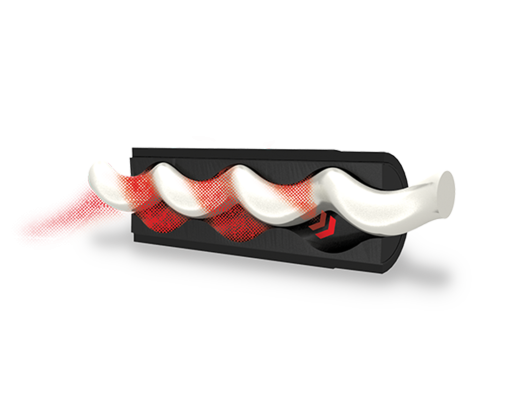
Moineau™ Progressing Cavity Pumps
for high-viscosity, fragile, or high solid-content fluids
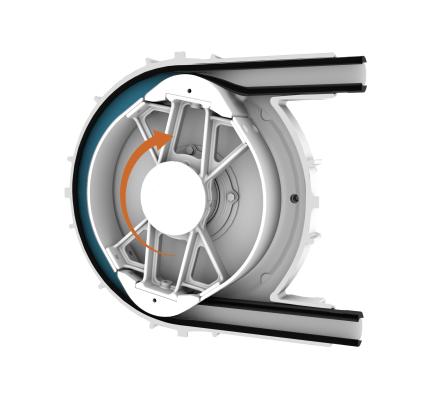
Peristaltic Pumps
for hygienic, low-shear application, abrasiveness and hard dry matter applications
Piston pumps
for dosing applications needs accuracy and repeatability
Diaphragm pumps
to handle aggressives or corrosives products with high accuracy
Our expertise ensures optimized performance, reduced maintenance, and long equipment life across a wide range of industries.
 TECHNOLOGY
APPLICATIONS
BENEFITS / ADVANTAGES
PERFORMANCE
 Progressing Cavity Pumps (PCP)
- Food processing industries: dairy, fruit, eggs, yogurt, cosmetics...
- Industry processing industries: mining, chemicals, wastewater, pulp and paper, energies, biogas...
- Gentle product handling, strict hygiene standards, product respect
- Easy to maintain, low shear pump, proportional flow rate
- Low life cycle cost, reversible, pulsation-free
- Handle a wide range of fluids (corrosive, fragile, viscous...)
- Suitable for abrasive product and with dry matter content
- Pressure: up to 330 bar
- Flowrate: 3 l/h – 500 m³/h
Particle size: up to 48 mm
 Peristaltic Pumps
- Used at all stages of processing in the food sector: handles sensitive or abrasive liquids
- Used for dosing and transferring in the chemicals, environment, biogas, mining, paper, ... industries
- No seals needed (no leakage), reduce maintenance costs
- Easy maintenance: only the hose contacts the product
- Capable of running at different speeds, as well as dry running
- Self-priming
- Design to match with harsh application : high matter content, big and hard particles..
- Pressure: up to 15 bars
- Flowrate: 30 l/h – 100 m³/h
Viscosity: 40,000 cPo
 Piston Pumps
- Dose fluids with particles with a high level of accuracy at high flow rates
- Dosing pumps are adept at working with a spectrum of fluids (corrosive, abrasive, viscous)
- Accurate dosing and excellent repeatability
- No emulsion, no aeration, no shearing: respect of the pumped product
- Handles a range of fragile fluids with solids and particles
- Minimal product shearing or aeration
- Easy to maintain
- Pressure: up to 20 bars
- Flowrate: 0.5 l/h – 350 l/h per pumphead
- Speed: up to 60 strokes/min
- Accuracy: ±0.5%
Particle size: up to 48 mm
 Plunger Pumps
- High-pressure cleaning, reverse osmosis, chemical injection, water jet cutting
- Very high pressure
- High mechanical efficiency
- Precise flow control
- Long life under extreme conditions
- Suitable for homogeneous products without particles
- Pressure: up to 3,000 bar
- Flowrate: up to 1,000 l/min
 Diaphragm pump
- Chemical dosing, wastewater treatment, food and beverage, mining, paints, acids
- Leak-free (sealless)
- Can handle aggressive or corrosive products
- Self-priming, can run dry
- Mechanical efficiency and reliability
- Pressure: up to 12 bar
- Flowrate: 0.1 l/min – 945 l/min
Particle size: up to 10 mm
 Screw pumps
- Oil & gas, marine, power generation, food and chemical industries
- Continuous, pulse-free flow
- Handles high viscosity and multiphase fluids
- Quiet operation, high efficiency, high speed capacity
- Small general arrangement
- Pressure: up to 120 bar
- Flowrate: up to 1,500 m³/h
 Vane pumps
- Fuel transfer, chemical dosing, lubrication, hydraulic and refrigeration systems
- Smooth, low-pulsation flow
- Self-priming
- Good suction capacity
- Handles low to medium viscosity and non-abrasive fluids
- Small general arrangement
- Pressure: up to 15 bar
- Flowrate: 1 l/min – 1,000 l/min
- Viscosity: 1 – 500 cPo
 Lobe pumps
- Food and beverage (dairy, sauces, chocolate, beverages)
- Environmental and wastewater applications
- Hygienic design (CIP/SIP compatible)
- Gentle, low-shear handling
- Reversible flow
- Easy maintenance and cleaning
- Suitable for non-abrasive and non-viscous products
- Pressure: up to 20 bar
- Flowrate: up to 1,000 m³/h
- Viscosity: up to 1,000,000 cPo
 Gear pumps
- Used in lubrication systems, hydraulic power units, polymers, oils, fuels, paints, adhesives
- Constant flow independent of pressure
- Compact, reliable, precise dosing of viscous fluids
- Handles high-viscosity products
- Suitable for non-particles fluids
- Pressure: up to 210 bar
- Flowrate: 0.1 l/min – 200 l/min
- Viscosity: up to 1,000,000 cPo